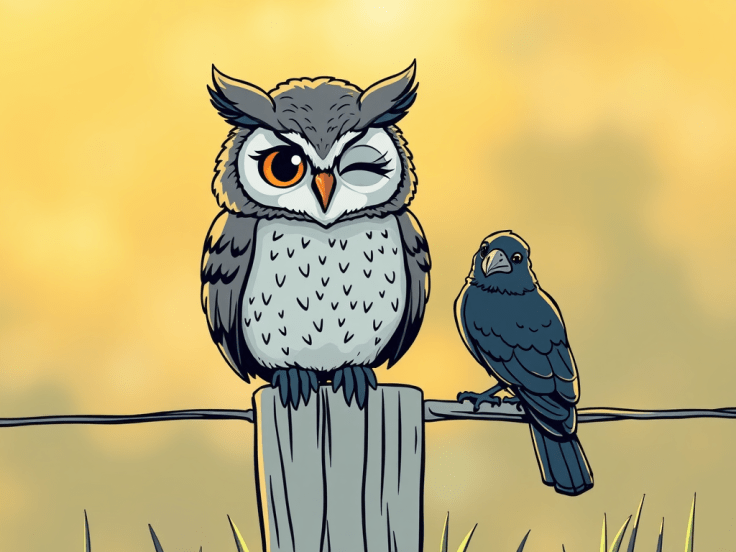
The Owl and the Crow
by Bryant Burroughs
Many strange things have happened in the Deep Forest during its long years, but none so strange as the story of an owl and a crow becoming best friends. It’s not that crows and owls are unfriendly creatures. It’s simply that crows arise at dawn, caw noisily, love to fly from treetop to treetop, and prefer to stick together as a big family, while owls are happiest sitting alone in a tree or barn, especially when basking in moonlight.
Then came the day that a crow who couldn’t caw met an owl who couldn’t see.
At the very top of the tallest tree in the Deep Forest, overlooking a meadow shining with yellow and white wildflowers, a young crow warbled. Then it cocked its head and gurgled. Finally, it clicked its bill in a sharp rattling sound. It desperately hoped for a return cry from the flock of crows flying away toward the distant tree line, but no matter how it cocked its head and listened, it heard nothing. If a crow could cry, this young one would have soaked the leaves with tears. But all it could do was flex its wings and coo in sadness. I’ll never belong.
He had been born the year before, his mother’s very first birth. She marveled at his beautiful, sleek black feathers and considered him the most handsome baby crow in the Deep Forest. She beamed with pride when he learned quickly how to keep his feathers clean, walk and hop in the field, and trust his wings to the air so that he could fly to find corn and grain and strawberries in the surrounding fields. Crows love to talk, and he quickly learned from her how to gurgle, warble, and make many other sounds. But he couldn’t caw.
A crow who can’t caw is like a sentence without words. “Caw! Caw! Caw!” is the communal language of crow families, shouted to call each other from distant trees or warn of danger, or direct the flock as it flies. From his perch in the tallest tree, the sad little crow watched his family soar farther away in the distance, cawing to each other, but not to him. Only his mother looked back for one mournful glimpse of her little one. I’ll never belong, he thought again ….
In his anguished loneliness, the crow didn’t notice the Great Horned Owl perched on a fence post at the meadow’s edge. She, too, was looking at the sky toward the crows, blinking her yellow eyes repeatedly. But no matter how she turned her head and strained her eyes, her right eye detected only blackness.
The ten-year-old boy who lived in the yellow farmhouse in the nearest pasture would live his entire life never knowing the trauma he had caused by a single careless act. Nor would his father, who had made him the slingshot for his birthday.
The boy was accustomed to seeing the owl perched on the roof of the red barn behind the farmhouse, relishing the glint of moonlight and rhythmic songs of crickets, yet alert to the tiniest movement of a field mouse scurrying toward the hay and corn in the barn. She would swoop down on her prey long before the two cats asleep in the hay knew anything was happening. The owl often hooted a greeting to the boy when he walked to the barn to feed the cats their evening meal, and he would return her greeting with a “hoot-hoot.”
On the evening of his birthday, however, she didn’t notice the slingshot sticking out of his jeans back pocket. The owl leaped into flight just as she heard a whoosh. The walnut-sized stone struck the barn wall inches below the roof and shattered into tiny pellets. She screeched as a scorching pain engulfed her right eye and nearly knocked her to the ground, but she closed her throbbing eye and urged her strong wings to push faster, and soon the red barn and betraying boy were far behind her. She was safe. But not unhurt.
She raced to the creek whose cold waters flowed out of the Deep Forest and shivered as she splashed her face over and over into its frigid, fast-flowing shallows. After a few minutes, the pain in her right eye began to subside. It hurt a bit to open her eyelid, so she dunked her head again in the soothing creek water. After shaking her feathers dry, she looked up at the half-moon and was shocked by the damage inflicted by the boy’s slingshot. Her injured eye was blind.
What does it mean to be an owl? The owl thought on these words all night in the milky moonlight. All she had ever wanted was to be an owl, a normal owl with vision so sharp that she could spot mice and frogs and beetles as they scurried across the forest floor. Now she had only one good eye. Would it be enough?
Many days and nights passed for the orphan crow and the one-eyed owl in the Dark Forest. They were aware of each other. The owl knew there was a crow around because the black creature never did anything without being loud. To the owl, the crow seemed to assume that raucous, piercing sounds were required in order to fly or sit on the tip-top of a tree.
For its part, the little crow knew the owl lived in a nearby tree and, like all crows, it was curious about its neighbor. It was especially puzzled by the owl’s odd eating habits. Many times the owl landed off target of its intended prey and pecked furiously as if unsure a prey was there at all. When this happened, the frightened field mouse scurried back and forth to avoid the owl’s pecks and sharp talons, and sometimes escaped to tell its family tall tales about its bravery. The owl was left only with hunger pangs.
It seems confused, the crow thought to himself. Maybe it doesn’t like the flavor of mice. It’s not my favorite unless I’m really hungry. That must be it!
The very hungry owl watched the black crow fly back and forth between the surrounding fields and the corner fence post at the meadow’s edge. With every flight, it grew more excited and louder than usual. On its last trip, it perched on the fence post, looked toward the owl, and gurgled before soaring to its tree.
Owls are as patient as cats and perhaps as smart as crows, although crows would argue that point. Why was that crow flying back and forth, she wondered. And why was it on my fence post? Did it find that mouse I was chasing? Her empty stomach growled. Before her injury, she ate a half-dozen mice, voles, or squirrels every night, plus snacks of grasshoppers, spiders, or snakes. Without both eyes working in tandem, though, she was eating half her usual diet.
She thought for a long time. The moon was glistening high overhead when the owl spread her wings and landed at the fence post. There was no mouse. Instead, she found piles of sunflower seeds, kernels of corn, and strawberries spread on the ground. It wasn’t owl food, but she enjoyed the sweet, nourishing strawberries.
While the owl slept the next day, the crow inspected the foodstuffs at the fence post and leaped into the air again. When the owl awakened with the moon, she drank from the creek and began listening and peering all around her, alert for the tiniest sound of food. A gurgle from a nearby tree reminded her of the sweet strawberries she had feasted on the night before, and, before she realized how odd it was to hear a sound from a crow at night, she had landed on the ground in front of the corner fence post.
Yes! she thought to herself. Strawberries! The famished owl pecked and gulped their refreshing juices before turning to the other piles of food. Next to the strawberries were blueberries. Then a collection of spiders, beetles, and even a butterfly from the sunflower field. And last, a mouse.
She was still feasting when she heard a familiar gurgle. The crow had landed quietly on the adjacent fencepost and now seemed to be greeting her. The two looked at each other until the owl surprised the crow by returning her own version of a gurgle.
The crow bounced up and down in joy, cocked its head, and gurgled its happiness. He didn’t know that the owl had been listening to the crow’s calls and had worked out the meaning of a few sounds. Then she had practiced for days trying to match the pitch she heard from the crow’s gurgling.
From that day, the two shared a tree as best friends. Yes, the crow chattered a lot, but the owl was the best listener in the forest. And she always had the silence of the night when the crow slept standing up, as do all crows.
The Dark Forest marveled at the wonder of the story and sent eagles and hawks flying to forests far and near to tell the tale of an owl with one eye and a crow who couldn’t caw.
About the Author
Bryant Burroughs is the author of two poetry collections: Where Do My Words Go?: Poems About Things I Hope Are True and Graced Perception: Poems from the Edges of Hope. He is also author of the novella, Once Upon A Time in Swansea.
Next (Story: Fight Rules) >
< Previous (Story: Hope at Sunrise)
Image is AI-generated.
